


County Gaol and Bridewell, Salisbury, Wiltshire
A County Gaol was in operation Fisherton Anger from at least 1421. (The parish of Fisherton Anger ceased to exist in 1904 when it was absorbed into the city of Salisbury.) A new building was erected in 1569-78 at the south side of Fisherton Street, adjacent to the River Avon. In 1631, a county Bridewell, or House of Correction, was added to the premises.
In 1784, John Howard wrote:
GAOLER, Thomas Biggs.
Salary, none. But £80 a year (lately raised from £50) to supply Felons as below.
Fees, Debtors, £1 : 1 : 0.
Felons, £0 : 7 : 8.
Transports, £4 : 4 : 0 each.
Licence, for Beer and Wine.
PRISONERS,
Allowance, Debtors, none.
Felons, a penny loaf a day each (weight in Sep. 1774, 8 oz.) : now 2d. a day; i.e. 1½d. bread (weight in Feb. 1782 , 15 oz.), ½d. a pint small beer.
Garnish, Debtors Master's-side, £0 : 8 : 8.
Felons and Common-side Debtors, £0 : 4 : 4.
Number,
| Debtors. | Felons &c. | |
| 1773, Dec. 13, | 14 | 8. |
| 1774, Sep. 23, | 12 | 9. |
| 1775, Dec. 27, | 21 | 15. |
| 1776, Sep. 3, | 7 | 12. |
| 1779, Mar. 1, | 17 | 15. |
| 1782, Feb. 27, | 20 | 16. |
CHAPLAIN, Rev. Mr. Vanderplank.
Duty — Friday.
Salary, £40; of which £20 is a Legacy.
SURGEON, Mr. Crompton, now Mr. Curtoys.
Salary, £10 : 10 : 0 for Felons and common-side Debtors, now £21.
THE PRISON in this City called Fisherton-Anger Gaol (from the name of the Parish in which it stands) near a fine stream, is also one of the county bridewells. Only one yard. No day-room for common-side debtors, nor felons: each sort have their fire (no fuel is allowed by the county) on a brick hearth raised in the middle of their respective lodging-rooms, without a chimney. The common-side debtors room over the felons. Women-felons have a separate room, about 15 feet square.
Mr. Biggs has £6 : 13 : 4 Salary for the Bridewell; and £10 a year for Fees of Prisoners acquitted at Quarter Sessions. He pays land and window-tax.
In 1776, there was a new building in the court; a stable, cart-house, and brew-house; with an infirmary over them, one room for men, another for women. I could not help wishing that the lower part instead of stable &c. had been two day-rooms with fire-places, one for debtors, another for felons. That part of the prison which was the bridewell is not secure; and petty offenders are confined in the gaol.
Just without the prison-gate was a round staple fixed in the wall: through it was put a chain, at each end of which a common-side debtor padlocked by the leg, stood offering to those who pass by, nets, laces, purses, &c. made in the prison. The two whom I saw there last were crown debtors not cleared by the insolvent act. Now, this is not permitted.
At Christmas, felons chained together are permitted to go about; one of them carrying a sack or basket for food; another, a box for money.
Twenty pounds a year of the chaplain's salary is paid by Lord Weymouth by a bequest of Thomas Thynne, Esq. who bound for payment the manors of Weobly and Ross in the county of Hereford. The bequest was recognized by Lord Weymouth in a deed of settlement dated 2d of November 1709.
Lord Pembroke pays a legacy of £5 a year out of the manor of Swallow Cliff in this county; part to the chaplain himself, viz. a guinea for a hat; the remainder to be by him distributed among the prisoners. Mr. Smith of Salisbury left the interest of £50 to be divided among them. No memorial of any legacy hung up in the gaol. The act for preserving the health of prisoners not hung up.
| Die Julii, 30. Georgii II Anno Dom 1729. | |
| A TABLE of Fees now and heretofore usually demanded — and also for Chamber-rent &c. — according to an Act —intituled an Act for the Relief &c;. | |
| £. S. D. | |
| For entering and discharging every action or process capias or latitat | 1 : 0 : 0 |
| Entering and discharging every second action | 0 : 10 : 0 |
| Entering and discharging every capias ulgat | 0 : 10 : 0 |
| For the under keeper or turnkey each action and writ | 0 : 1 : 0 |
| FELONS. | |
| For every commitment and discharge by a justice of peace or in court | 1 : 5 : 4 |
| For every commitment for not finding bail for good behaviour | 0 : 13 : 4 |
| For every commitment and discharge of bastardy | 0 : 13 : 4 |
| For every ignoramus upon felony | 0 : 13 : 4 |
| For every commitment and discharge on the statute of præmuire | 1 : 5 : 4 |
| To the under keeper on each of the causes | 0 : 1 : 0 |
| LODGINGS. | |
| Every prisoner that lyes in the keeper's lodgings in the Prize or Sheriff's ward pays by the week | 0 : 2 : 6 |
The prison was enlarged in 1783 by the addition of a three-storey block to accommodate felons, with eight cells on each floor. In 1791, Howard reported:
The cells being too few, when the felons are numerous, two or three are crowded into one cell. This was the case in 1784 when seventeen prisoners and one turnkey died of the gaol fever. The felons then were kept in close confinement: now they are out only one hour in a day. Act for preserving the health of prisoners not hung up: no bath, though the prison is so conveniently situated, being near a fine stream of water. The gaol not whitewashed since the sickness in 1784. Here the acquitted prisoners that are poor are kept in irons till the judge leaves the town, but others are immediately discharged.
No part of this prison is now a bridewell; yet the warrants are expressed "to be kept to hard labour." The stable and cart-house still continue, though many common-side debtors and petty offenders are crowded into a smoky room adjoining. Surgeon, Mr. Robert Still; salary now £21. Gaoler’s salary only £50.
Following the closure of the Salisbury Town Gaol in 1785, prisoners from the city were housed at Fisherton Anger, an arrangement that was formalised in 1800. A further twenty cells were added in around 1792, and separate yards added for felons and debtors. In 1807, two rooms were allocated as infirmaries.
In 1812, James Neild wrote:
Keeper, James Waight; now John Willis. Salary, 150l.
Fees, as per Table: Besides which the Under-Sheriff demands 6s. 8d. for his Liberate! For Conveyance of Transports, Five Guineas each.
Garnish, for Debtors on the Master's-Side, 2s.; on the Common-Side, 1s.
Chaplain, Rev. John Malham; now Rev. Mr. Harrison.
Duty, Prayers and Sermon on Sundays. Salary, 50l. See the Remarks.
Surgeon, Mr. Still; now Mr. Fisher.
Salary, 21l. for Felons and Common-Side Debtors.
Number of Prisoners,
| Date | Debtors. | Felons &c. |
| 1800, June 9th | 12 | 21 |
| 1802, Jan. 1st | 12 | 24 |
| 1803, Oct. 26th | 16 | 24 |
| 1806, Oct. 6th | 14 | 11 |
| 1807, Sept. 25th | 14 | 30 |
Allowance, formerly to Debtors, none. See Remarks. But in 1804, the Magistrates humanely granted to the Poor, or Common-Side Debtors, one pound and a half of bread each per day; and at the Easter Sessions they increased it to one pound and three quarters. It is sent, in loaves to that amount, from the Baker's, and I have found them to be of full weight.
Felons and Petty Offenders have a loaf daily of best wheaten bread, weighing one pound and ten ounces.
REMARKS.
This Prison, called Fisherton-Anger Gaol, takes its name from the Parish in which it stands, near a fine stream; and is also one of the County Bridewells.
On the outer-gate, towards the street, is painted, Pray remember the Poor Debtors' Box.
The Debtors' court-yard, which is separated from that of the Felons, by a double iron palisade, (placed at such a distance as to prevent their conversing with each other,) is sufficiently large to admit of the Debtors' playing at Tennis, Fives, &c. There is no day-room either for them or Felons; but two might very conveniently be made, where a cart-house and stables now stand.
For Master's-Side Debtors there are four rooms in the Keeper's house: one of which, 11 feet square, has a fire-place in it, and four beds at 2s. 6d. per week, two sleeping in a bed: But if any Debtor have a room and bed to himself, he pays 5s. per week.
Common-Side Debtors have only one room to eat and sleep in, of 20 feet by 16. It was formerly without bedding, or even straw: but in 1804, the County kindly allowed a straw-in-canvas bed, and two blankets, to every poor Debtor gratis. Here is a fire-place, but no firing allowed. The room was extremely dirty, not having been white-washed for many years. Over this are two rooms, (to which the ascent is by a stone stair-case from the court-yard,) set apart for Infirmaries: These have also fire-places, but were equally dirty as the former, and filled with lumber. In the smaller room Women Debtors are occasionally confined. At my last visit, in 1807, I found this room clean, and a Woman in it.
The Felons' court-yard is separated from that of the Debtors, on one side by a wall, and on the other by palisades, as above noticed. It is 65 feet by 34; and at the upper end of it are four small arches, for the Prisoners to stand under, if it be rainy when they are let out.
Their sleeping-wards are close to the river, and consist of three stories: That on the ground-floor has twelve cells, of about 10 feet 6 inches by 9 feet 6, and 9 feet high to the crown of the arch. Each cell has two wooden doors; the inner one, with an iron-grated aperture, of 7 inches by 4; and on the opposite side of the cell is an iron-grated window, with inside shutters. Every cell contains a wooden bedstead, straw-in-sacking bed, and one or two blankets. The floors are of brick, and all the cells open into a narrow passage, hardly 3 feet wide.
The next story contains sixteen cells, and the upper story has the same number. In the centre of each story is a sewer, with a water-pipe well supplied, to prevent its being offensive. On the two upper stories the Turnkeys have their sleeping-rooms; and at the top of the whole building is an alarm-bell.
The Chapel is on the Debtors'-Side of the Prison, and has a pew for the Gaoler, but no gallery. The Debtors are placed on one side; the Felons on the other; and the Women in the middle of the area, in sight of, and almost close to each other. Any Debtor refusing to attend Chapel is locked up during Divine Service; and it is the custom here, to lock up every Debtor in his room, from two o'clock on Sunday till four, that the Turnkey may go to Church. Ever since the accession of the late Chaplain, Mr. Malham, in 1796, and the appointment of Mr. Harrison, his immediate successor, the sacred Service has been regularly performed. Previously, however, great complaints were made of sad remissness in this respect; which (exclusive of other considerations) was doubly cruel, as it deprived the Prisoners of wholesome air, by thus being locked up the whole day.
In fact, this Gaol has received little improvement since Mr. Howard visited it in the year 1788; and "it still retains all the severities of the Old School." This, however, is the more to be wondered at, as I am assured that the Gaol is frequently visited by the Magistrates. The old Keeper, (now dead,) paid no attention to my Remarks, in the several visits I made for years together. Security from escape, by main force, seemed to be his chief, and indeed his only object.
At my last visit his Widow said, "that during the whole time her Husband kept the Gaol, which, I think, was six and twenty years, there had not been one Escape." From what I had seen, this did not surprise me; but I was never able to learn the number of deaths within its walls; nor, indeed could I procure any book or account relative to it. There were no Rules and Orders; and it was with much difficulty that, in 1802, I could make out the following useful document, which is now not legible.
| TABLE OF FEES. | |
| £. S. D. | |
| For entering and discharging every Action on process, Capias, or Latitat | 1 0 0 |
| Entering and discharging of every second Action | 0 10 0 |
| Entering and discharging every Capias utlegat. | 0 10 0 |
| To the Under-Keeper, or Turnkey, each Action or Writ | 0 1 0 |
| Felons' Fees are abolished. | |
There does not appear to be any Examination made either into Receipts or Disbursements in this Gaol; the whole seems to rest with the Keeper. I could obtain no account of the several monies arising from Donations to the Prison, since my visit in 1802 to the last. The Gaoler said they were lost, or destroyed.
Of the Chaplain's Salary of 50l. twenty pounds per annum is paid by Lord Weymouth, as the Bequest of Thomas Thynne, Esq. who long since bound for the payment the Manor of Weobly and Ross, in the County of Hereford. The Bequest was recognized by his Lordship in a Deed of Settlement, dated 2d November, 1709. The Bishop of Salisbury sends every Christmas forty shillings worth of meat, and twenty shillings worth of bread. The Earl of Pembroke pays a Legacy of Five Pounds a year out of the Manor of Swallow-Cliff in this County; part to the Chaplain himself; viz. a guinea for a hat; and the remainder to be by him distributed amongst all descriptions of Prisoners. The one pound fifteen shillings, being the interest of fifty pounds, left by Mrs. Smith of Salisbury, is likewise divided amongst them.
No Memorial of any Legacy is displayed or hung up in the Gaol. Every Christmas, one of the Turnkeys goes through the City, and adjacent parts, with the box before-mentioned. The Collection, when I was here in 1802, amounted to 9l. 18s. 4d. and it is regularly laid out by the Keeper, as he informed me, in purchasing meat for the Felons.
I cannot close this narrative without a few Remarks on the Felons' Gaol. Their cells are very damp, and the lobbies, or passages, only three feet wide. Young Novices in vice, and inveterate Offenders, Vagrants and faulty Servants, are alike promiscuously confined here; and when let out for airing, it is but for one hour only out of the twenty-four. I happened to be there during that hour in the wintry month of January, 1802. There was a heavy fall of snow, sleet, and rain; it was extremely cold; and yet, upon opening their door, the Prisoners (seventeen Felons, and seven for Misdemeanors) rushed out into the midst of it, eagerly gasping, as it were, for a mouthful of fresh vital air. Some of them were cruelly ironed with a sort of fetters, called Bolts and Sheers: Under the former of these the Prisoner cannot move either foot four inches before the other: the latter having a joint in the middle, he may walk, though with difficulty; but his feet, both night and day, are kept 13 inches asunder.
I saw here no proportion of punishment for the several offences, and, consequently, no suitable distinction of guilt. A run-away apprentice, only 13 years of age, was amongst those let out for air and exercise; and, like the rest, associated with a number of the worst description.
Prisoners under Sentence of Death are executed in the Gaol-Yard, and the Church bell tolls. The Felons are brought out of their cells, and placed in the Chapel, in full view of the awful ceremony; and the Debtors are locked up till it is over.
No County clothing is yet allowed; and of course I found the Prisoners miserably ragged and dirty. No bath supplied, although one might so easily be made from the adjacent river of fine water. No oven to purify infected or offensive apparel. I understand the Earl of Radnor has determined to bring the subject of clothing before the next Quarter Sessions.
The Debtors' lodgings are very highly charged, at 2s. 6d. per week, for two sleeping in a wretched old bed, destitute of curtains; and four beds in one room.
Since the appointment of the present Gaoler, the Clauses against Spirituous Liquors are stuck up, but not the Statute for Preserving the Health of Prisoners.
It has given me great pleasure to find by the papers, that this abominable Gaol is to be presented as a nuisance; and that the County intend soon to erect a new one; for whose Government it is devoutly to be hoped, that good Rules and Orders will be not only established, but enforced.
The new prison alluded to by Neild was erected between 1818 and 1822. Like its predecessor, it was located in Fisherton Anger at the north side of the present-day St Paul's Roundabout. The architect was Thomas Hopper Junior. A view of the buildings is shown below:
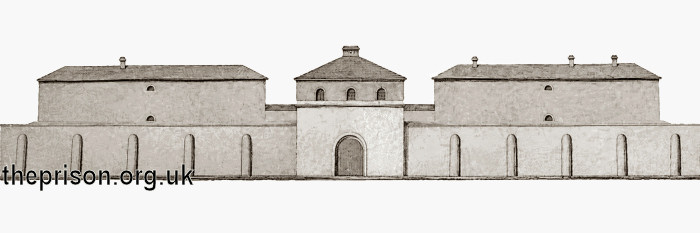
New County Gaol and Bridewell, Fisheron Anger, c.1822.
In 1823, it was reported:
This new prison, which was completed only last autumn, is built to receive one hundred prisoners. The governor's house, which is large, is placed in the centre; on both sides of it there are two wings, containing the prisoners' wards and cells,—the whole plan representing an outline very similar to that of the letter H placed sideways. Two airing yards are laid out on both sides of the centre building, which alone are under inspection from the governor's windows. Behind the centre building is placed the chapel, with two small yards for the female prisoners. This arrangement provides the following very limited extent of classification; two classes for the females, and four classes only for all descriptions of male prisoners to be met with in a county gaol; viz. debtors, felons and misdemeanants for trial, transports, capital felons, and juvenile prisoners. This error in the plan of a prison erected so recently, is exceedingly to be regretted; the consequence of which is, that the tried and the untried felons are confounded together, and no distinction made with the juvenile prisoners; the females also must be subject to very imperfect classification.
The four airing yards for the male prisoners are very large; they are bounded next the centre by an iron pallisade, but at their further extremity the boundary consists of a very lofty brick wall, about thirty feet or more in height, which extends across from wing to wing. As the prison is completely surrounded by an excellent boundary wall, it would have been far preferable to have had the usual iron pallisade mounted with chevaux-de-frise, as the outer boundary of the yards, in the place of this lofty brick screen, which must interfere with the airiness of the prison. The area between the centre building and the yards exposes the governor's movements, who observed that he was in consequence completely overlooked by his prisoners.
The interior of the prison appeared to be of excellent construction; the day-rooms are well floored with stone, and they are light and airy; their ceilings are neatly turned in arches, supported by cast-iron rafters on columns of the same metal. The night-cells are also very well contrived; each has a small vent-hole in the cieling; the windows are glazed, and are high enough to be inaccessible to the prisoner. The bedsteads are made of cast-iron trellice, fixed on low supports to the floor; each cell has also two doors, one of strong iron trellice, the other of wood closely fitting into the frame. These cells may be recommended as complete models for the construction of this part of a prison. Nothing however can compensate for the present very erroneous design of this new prison, exhibiting such a lamentable deficiency in respect of classification. The bedding allowed is three blankets in winter, and a straw mattress; also a flannel night-cap. From each cell-gallery, sound-pipes pass into the bed-room of the governor: they are made of copper, terminating with a wide funnel, which is fixed up under the arched cieling at the end of each cell-gallery: by means of which sounds may be conveyed from every gallery to the governor's lodging room. But it happens, from the faulty arrangement of the prison buildings, that the access from the governor's house and bed-room is so inconveniently distant from all the galleries, that it is feared the useful object of this contrivance must be greatly lost. One attempt at an escape has already occurred, by endeavouring to pierce one of the walls with a piece of tin which had been in use as a bread knife. Irons are used on transports and capital felons; the irons weigh about ten pounds.
In the yard for bridewell prisoners there is a pumping machine turned by a windlass, for the employment of prisoners sentenced to hard labour from the city of Salisbury: all others appeared to be entirely unemployed. There are three turnkeys and a matron. The allowance of food is one pound and three quarters of the best white bread per day.
The number of prisoners in this gaol has not hitherto amounted to 100, the average number in confinement being about 60.
The infirmary, which consists of two rooms, has not yet been used: the prisoners are very healthy. The chapel, which is in the same building, is very neat and plain; the prisoners are seated in partitions, by which the classes are secluded. One insane prisoner is now in confinement; he was committed on charge of a robbery, and proved to be insane. The prison occupies about three acres of ground.
The outer wall deserves the particular notice of those concerned in building gaols; it is about twenty feet high; its abutments are carefully rounded off, so as to present no edge or angle; the upper part of it is made to taper off to the thickness of a single brick, and the summit of the wall is mounted with three tiers of detached bricks, by which no support can be obtained for scaling it. The porter's lodge is remarkable for its perfect simplicity and neatness; no superfluity, no expensive or useless ornament is to be seen upon this part of the prison, upon which it has been so common to allow county architects to indulge their taste, and in some few instances in the most lavish manner. The front gate requires a small grated wicket, to allow the porter to see strangers before he unlocks the door to admit them.
By virtue of an Act "for rebuilding the Council Chamber of New Sarum," 25 Geo. 3, the city of Salisbury are enabled to commit their prisoners to the county gaol; the city is charged for the clothing and feeding, &c. of their own prisoners, and it pays a small salary to the gaoler, independent of the county. In the recent act for rebuilding this county gaol, some further enactments occur relative to this excellent arrangement. During the last half year about twenty-six prisoners have been received from the city of Salisbury.
The following year, the prisoners were divided into ten classes and a machine was constructed for raising water by manual labour.
In 1837, the Inspectors of Prisons reported on the prison:
Construction.
THERE are 10 yards, containing 10 pumps, and 12 privies. Two of these yards are appropriated to male debtors, and one to female debtors. There are four day-rooms for male prisoners (one of which, however, is only a shed, without a fire-place), but none of them are used at present. Here is also a day-room for the female prisoners, which is still occupied. There are four dark cells. The dark cells for the men require to be better ventilated. The cells which are used for this purpose for the females are rendered dark only by shutters. The yards are all gravelled and partially paved.
| Number of cells where only one male sleeps | 92 | <|
| Number of cells where only one female sleeps | 4 | |
| Total number of sleeping-cells, separate | — | 96 |
| Number of sleeping-cells where more than one male prisoner can sleep | 2 | |
| Number of sleeping-rooms where more than one female can sleep | 4 | |
| 6 | ||
| — | ||
| 102 |
The usual dimensions of the cells are 9 feet high, 7 feet 6 inches long, 6 feet 6 inches wide. There are six double rooms and one day-room in the sheriff’s debtors’ ward, which, if divided, would make 15 single rooms.
Management.
I found the gaoler in bad health; he is about 70 years of ago. His nephew acts with him and for him. The prison is extremely clean, neat, and dry, even after a long continuance of wet weather. Two points require correction, and can be most easily set right. The diet is not defined by any minute rule, either printed or manuscript; it exists, indeed, rather by usage than by any ordinance. There is an extreme laxity in regard to letters and visits. Twice a-week both the convicted and the untried are allowed to receive visitors during half an hour; any magistrate (not only the visiting magistrates) may give leave for a visit. Letters are admitted without any limit at all. Visits and letters are the greatest indulgence which a prisoner can experience. But the evil is not confined to himself; not only does this freedom render imprisonment more agreeable, but it diminishes and weakens on the part of the public the dread and disgust which a gaol should inspire. By frequent entries and exits, by personal observation, and by written communications, all the mystery and supposed gloom of incarceration are dissolved. But it is unnecessary to enlarge upon this topic. Some smaller deficiencies are—in two yards the privies have no doors, and the dark cells are not sufficiently ventilated. The little shutters which cover the grating in the outer door of the cells may be opened by the prisoner within, with a little art, and a communication may be easily established with his neighbours : this may be readily prevented as far as the power of opening the shutter extends. The women have not separate sleeping cells, but sleep in rooms containing two, three, or four, according to circumstances. The female prisoners are not generally numerous; but it would be far better to divide the present rooms into separate sleeping cells than to allow the very great indulgence and probable corruption of sleeping in the same apartment. One of these female dormitories might be advantageously .set apart as an infirmary for the female prisoners. The male prisoners all sleep in separate cells; but there tire rooms for male prisoners in which there are more than one bed.
Those who are sentenced to hard labour at the assizes and sessions are sent to the House of Correction at Devizes; but those who are sentenced to hard labour by the magistrates’ bench, both of the county and of the city of .Salisbury, are kept here.
No new cells are at present in contemplation, only the conversion of the day-rooms into cells. Separation and silence are enforced in a moderate degree.
Prison offences are punished by confinement in a cell without exercise for two or three days; the dark cell is rarely resorted to, and only in cases of resistance: the diet is never reduced. Several prisoners are said to have committed little offences in order to escape the ordinary exercise in cold weather. When whipping is ordered, the usual number of lashes is two or three dozen, the instrument is a cat-of-nine-tails made of whipcord.
During 14 years only one attempt at suicide is known to have been made; a knife which had been thrown over was used; but the effort was unsuccessful.
Care of the Sick, Disease, and Mortality.
One moderately-sized room serves as an infirmary for the males. It will suitably accommodate six patients, but eight beds might be placed in it on an emergency. During 14 years, however, there have never been two patients here at the same time. It has two good windows, and a water-closet adjoining. There is also a bath. Either a male prisoner acts as nurse, or sometimes a female nurse has been engaged from the town. .Sheets are allowed to the sick, if ordered by the surgeon. There is no room specially appropriated as an infirmary for the females; but, if any one is ill, she remains in her own cell, or is removed to another more convenient cell. As all the female cells are much larger than ordinary cells, and contain fire-places, the women sustain no disadvantage through the absence of an infirmary. At the time of my visit one woman was ill, in a large cell (or, more properly speaking, room), with a fire; she had entered the prison unwell a fortnight before. No male was ill enough to lie in the infirmary during my stay.
The surgeon visits every three or four days, either himself or his assistant, and more often if requisite. He has been connected with the gaol more or less for 35 years. During the last year, from March 1835 to March 1836, only one case of illness occurred sufficiently severe to demand removal into the infirmary; and not one woman has been seriously diseased. The most common disorders are venereal ones, acute and chronic rheumatism, occasional slight attacks of fever, and itch. There has been no cholera, There is much ague about Salisbury; but there has IHJCU no case of it in the gaol during the last year.
As prisoners are confined here in separate cells, which are not heated, it is important to know the observation of the surgeon on this head. During the last winter neither the surgeon nor his assistant have seen any evil arising from this source. No prisoner has complaint to them of cold, with the exception of one weak old man, who was consequently transferred from his cell to the infirmary. But, in order to understand fully this statement, we must place in juxtaposition the circumstance that the prisoners who are thus separately locked up are allowed in this prison to take exercise during three hours, or three hours and a half, daily; consequently they are not so likely to sutler from cold as prisoners in other situations, who are not suited to take exercise in the open air for so long a time.
A few months before my visit the convicted prisoners had been allowed to receive food from without, as well as the untried. This liberty has been withdrawn from the convicted. The surgeon and his assistant have, however, seen no instance among the convicted in which indisposition has appeared to arise from the stricter diet. The prisoners have complained to them, it is true, of the lowness of the diet. In the opinion of the surgeon and his assistant, many prisoners go out in better health than on their admission. No case of scurvy has been seen.
The prisoners were remarkably healthy in their appearance: the statements which they made to me, as to the coldness of the cells, were so conflicting that I could not arrive at any conclusion; in addition to this, the prison had just been emptied of most of its inmates.
Diet.
Each prisoner receives daily 1¾lb. of the best wheaten bread, and soup on Sundays. Prisoners before conviction are allowed to receive eatables from their friends; convicted prisoners only the gaol allowance.
Debtors from the Courts are only allowed the bread from the county, and a bushel of coals a-week and 14 faggots during the 6 winter months. If destitute they receive bedding. Some of the master-debtors also receive bedding.
Bedding of Prisoners.
One straw mattress and two blankets in summer, and three in winter.
Clothing of Prisoners.
Clothing is only found occasionally before conviction. Felons after trial are put in party-coloured clothing, and misdemeanants after trial are put in dresses. The clothing is a cap, waistcoat, jacket, smallclothes, stockings, shoes, shirts, for men; cap, shift, stockings, shoes, gown, for women.
The diet is not sufficiently defined by rule, and seems to depend upon custom more than upon regulation. I subjoin the following extract from the printed rules relative to the diet:—
"If well behaved, they shall be sustained with bread, and any coarse but wholesome food, and water, according to a dietary to be directed by the visiting justices. No prisoner in the bridewell to be supplied with any food, drink, or money, from any fund or relation whatever."
The soup is made from ox-heads, but there is no regulation as to the number of heads to be used for a certain number of prisoners, but only a habit, I have recommended a revision of the above rule among other improvements.
Labour.
The labour consists in cultivating the land within the boundary-wall of the prison, and pumping water for the use of the prison. Very few prisoners are ever kept here after trial. Most under sentence go to the house of correction at Devizes for hard labour. Cleansing is another occupation; but an idea Is entertained of converting part of this gaol into a house of correction, by the erection of tread-wheels, &c., which may be easily done.
Religious and Other Instruction.
The chaplain has no other duty except an evening lecture on Sundays, at half-past six o’clock. He goes to the prison every day; he reads prayers daily, and performs divine service twice on Sundays, with a sermon in the morning. He keeps a journal, in which he records the number of prisoners (including the debtors) who attend the chapel. The debtors (at least those who are called master-debtors) are allowed to attend or not, as they think proper; a discretionary power which has a bad effect cm others as well as on themselves. If a dissenting prisoner makes an application, he is permitted to see a minister of his own persuasion, but in the presence of the chaplain: this latter caution exists in consequence of bad impressions produced by certain tracts said to have been formerly introduced. The chapel was formerly not sufficiently spacious to contain all tho prisoners, but an alteration took place in 1834, and no absence for want of room has since been necessary. There is sufficient accommodation now for 94 prisoners and debtors without kneeling; and for kneeling, 42 felons, 30 debtors, and 5 misdemeanants ; those numbers include both male and female.
There is a good supply of religious books. It sometimes occurs that prisoners have their own books; they are, in that case, not included in the above number.
The chapel is not heated in winter. A curtain ought to be placed in front of the female debtors, who sit at present in the gaoler’s seat in the gallery, and can look down on some of the men, and can also be seen by them. The sacrament is delivered, when application is made, which is rare; otherwise, it is only communicated to the condemned. The chaplain has seen no evil whatever to result from silence and separation; one prisoner alone, lately hung for murder, complained to him of tho cold, and the gaoler gave him an extra jacket. He has never heard any complaint of lowness of diet. The prisoners have the power of conversing freely with him in a private room; after service they have only to express their wish to that effect to the turnkey. The chaplain attributes a great proportion of offences to the beer-shops : most, if not all, who have been condemned, and left for execution, in his time, have imputed their end to some such source.
The prison was closed in 1870 because it could not meet the requirements of the 1865 Act, which required that a separate cell be provided for each inmate. In 1875, the site was sold off.
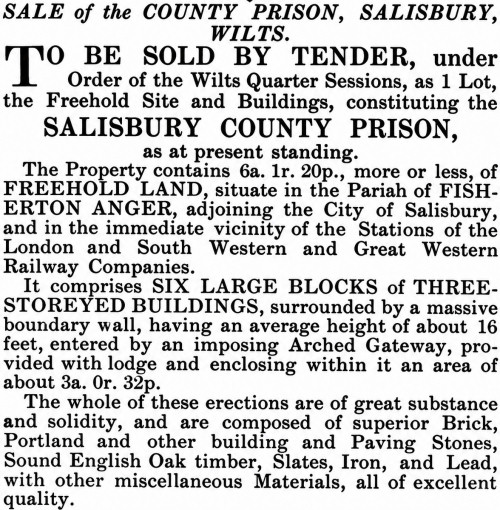
Adverstisment for sale of the gaol, 1875.
Most of the buildings were then demolished. Those that survived were the chapel and the large central block, which was converted into a private residence and became known as Radnor House. In 1901, the War Department leased the building from its then owner, Dr. W. Corbin Finch, and in 1922, bought it,together with the adjacent Nelson House and gaol chapel, from Mrs Baskin. From 1901 until the outbreak of the Second World War Radnor House was the headquarters of the 2nd Army Corps, later Southern Command.
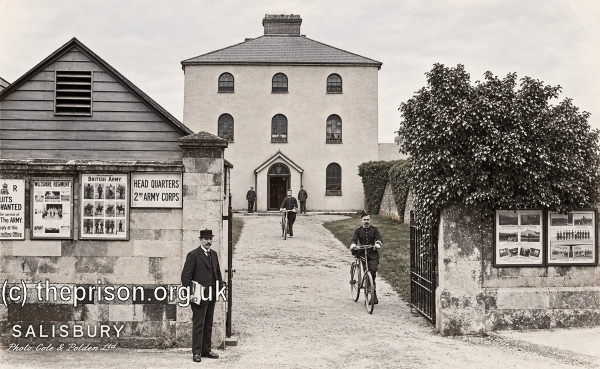
Entrance to Radnor House, Fisheron Anger, 1904.
The surviving gaol buildings buildings were demolished in 1969. None of the Fisherton Street gaol buildings survive.Records
Note: many repositories impose a closure period of up to 100 years for records identifying individuals. Before travelling a long distance, always check that the records you want to consult will be available.
- Wiltshire and Swindon Archives, Wiltshire and Swindon History Centre, Cocklebury Road, Chippenham SN15 3QN. Holdings include: Returns of prisoners awaiting trial, with details of crimes and sentences (1817-70); Returns to the Secretary of State on the numbers of prisoners at Devizes and Fisherton Anger. Notices appropriating the prisons to a particular class of prisoner, lists of prisoners, reports of the Gaol Committee, and related correspondence.
- The National Archives, Kew, Richmond, Surrey, TW9 4DU. Has a wide variety of crime and prison records going back to the 1770s, including calendars of prisoners, prison registers and criminal registers.
- Find My Past has digitized many of the National Archives' prison records, including prisoner-of-war records, plus a variety of local records including Manchester, York and Plymouth. More information.
- Prison-related records on
Ancestry UK
include Prison Commission Records, 1770-1951
, and local records from London, Swansea, Gloucesterhire and West Yorkshire. More information.
- The Genealogist also has a number of National Archives' prison records. More information.
Bibliography
- Higginbotham, Peter The Prison Cookbook: A History of the English Prison and its Food (2010, The History Press)
- Brodie, A. Behind Bars - The Hidden Architecture of England's Prisons (2000, English Heritage)
- Brodie, A., Croom, J. & Davies, J.O. English Prisons: An Architectural History (2002, English Heritage)
- Harding, C., Hines, B., Ireland, R., Rawlings, P. Imprisonment in England and Wales (1985, Croom Helm)
- McConville, Sean A History of English Prison Administration: Volume I 1750-1877 (1981, Routledge & Kegan Paul)
- Morris, N. and Rothman, D.G. (eds.) The Oxfod History of the Prison (1997, OUP)
- Pugh R.B. Imprisonment in Medieval England (1968, CUP)
Links
- Prison Oracle - resources those involved in present-day UK prisons.
- GOV.UK - UK Government's information on sentencing, probation and support for families.
Except where indicated, this page () © Peter Higginbotham. Contents may not be reproduced without permission.