

County Gaol, Devizes, Wiltshire
In 1808, Richard Ingleman, the architect of the prisons at Folkingham in Lincolnshire and Southwell in Nottinghamshire, presented Wiltshire's gaol committee with his proposed design for new county gaol to be built at Devizes. It was located in an airy situation on the Bath Road, near what became known as Prison Bridge, and construction work began in 1810. Though still incomplete, the new prison opened its doors in 1817. By 1821, there was accommodation for 130 inmates, with foundations in place for buildings to hold another fifty. The final cost prison cost of the scheme, including land, was £40,207 19s 7d.
The prison was designed on the panopticon principle consisted of a circular central administrative and supervisory building surrounded by a sixteen-sided outer building, with a walled yard lying between the centre and each of the sixteen outer segments, as illustrated below.
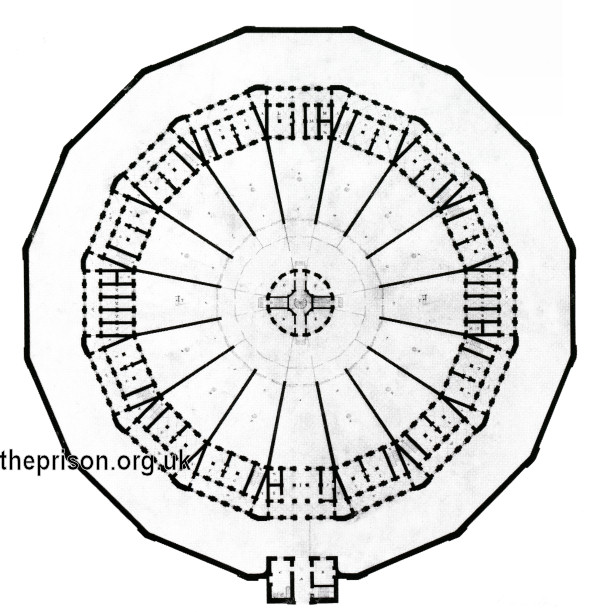
County Gaol, Devizes, Wiltshire, c.1808.
The central building contained offices and accommodation for the governor and taskmaster, and two infirmaries in its attics. Of the planned sixteen outer blocks, only ten were initially built, with an eleventh been added by 1867. A continuous corridor ran around the ground floor of the prison. At its inner side, work cells, dayrooms, sleeping cells, stores and various service rooms occupied the ground floor. The first floor contained further sleeping cells, while the blocks forming the four cardinal points of the design were left as tall open arcades. Thses provided for the free circulation of air and a place for prisoners to exercise in bad weather.
In 1821, it was reported:
The Governor resides in the centre; and from his windows he inspects the yards, which are enclosed by a circular range of building appropriated for the prisoners, at present extending only two-thirds of the circle, but which may at any future time be completed if wanted. This circular building contains 104 solitary night-cells; about forty solitary working-cells, for the use of the first class of prisoners, viz. felons; and also several good day rooms, which are in use by the remaining class, viz. misdemeanants, who work in companies. The passages to these rooms on the lower story being very spacious, are occasionally made use of : when visited, one of these was furnished with benches and a long desk, in which the younger prisoners are collected at school in the evening
The discipline to which the prisoners are here subjected is un commonly strict. The confinement of the first class, viz. the felons, during the former part (which in some instances has extended to twelve months) of their term of imprisonment, is in almost constant solitude. Each felon quits his separate night cell in the morning, to be locked up for the day in his solitary working-cell: here silence is strictly enforced; and, excepting an occasional visit from the Governor or Chaplain during the day, his only regular visitors are the taskmaster, who watches over his work, and the turnkey, who brings him his food, and unlocks him for half an hour only in the day, to take exercise in the yard; but he is still in solitude and in silence.
On their being first received into prison, they are informed, that if, during the first half of their term of imprisonment, they conduct themselves in an orderly and industrious manner, they will then be allowed to take exercise on Sundays in the yards of their respective wards, and be permitted to associate with those of the same class to whom such privilege may also have been granted. On the contrary, solitary 'confinement for the whole term of their commitment (with the exception of half an hour per day for exercise) will be awarded to those who in any way have been guilty of a breach of the rules of the prison. Some of the prisoners in their working cells, were knitting their own stockings, others making shoes, gloves, straw hats, or weaving shirting, blanketing, and cloth, for the prison service.
In each of the cells is placed a Testament, a Prayer-book, Crossman's Introduction to the Christian Religion, and occasiónally a sermon; and the Chaplain frequently visits and converses with the prisoners.
The prisoners are not allowed any share of their earnings, but when the period of their imprisonment is concluded, money is given to them as a gratuity, to enable them to proceed to their homes.
| The number of criminals committed in the year ending the | |
| 1st January 1817 was 207 |
These consisted of |
| Ditto . . . 1818 . . . 496 | |
| Ditto . . . 1819 . . . 482 | |
| Ditto . . . 1820 . . . 439 | |
| Ditto . . . 1821 . . . 504. | |
| seven have been committed under second warrants, four only of which number are for felony,” giving a ratio of 3.6 per cent. on the general aggregate, and the fraction of 0.8 per cent. on the felons! | |
Of the above 473 prisoners for felony, four only, during a period of more than five years, have been re-committed for the same offence. The Governor states, that from Hilary to Easter Sessions this year, eleven have returned to him who were in the prison before.
The second class contains the several descriptions of misdemeanants,and such of the first class whose term of solitary confinement, from good conduct, has been abridged by order of the Magistrates. These are employed at various kinds of work for the service of the prison, such as turning reels for the looms, clog making, also wooden soles for the prisoners' shoes, tailoring, spinning, &c.; these prisoners have rather a better ration of food; they also work at the corn mill, which is on the capstan plan, and requires sixteen men to work it at a time. The number of women is small in this prison; their employment is washing, making up and mending the prison clothing, which generally affords them full occupation. The average cost of food is from 2s. 4d. to 2s. 6d. per week each; the ration for the first class is 1¾ lb. of bread made in the prison, and 1lb. of potatoes; the second class has half a pound more of potatoes. The bedsteads are of iron, and the bedding is good. The cells are in admirable order; every where much cleanliness appeared.
In 1837, the Inspectors of Prisons reported:
The prison site is shown on the ZZ map below.

County Gaol site, Devizes, c.ZZ.
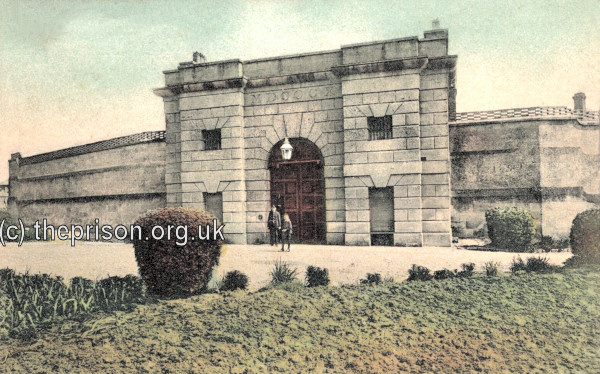
County Gaol, Devizes, Wiltshire, c.19XX. © Peter Higginbotham
Following the nationalisation of the prison system in 1878, the site became HM Prison Devizes.
The prison closed in 1914. The buildings no longer survive and the site is now EH
Records
Note: many repositories impose a closure period of up to 100 years for records identifying individuals. Before travelling a long distance, always check that the records you want to consult will be available.
- Wiltshire and Swindon Archives, Wiltshire and Swindon History Centre, Cocklebury Road, Chippenham SN15 3QN.
- The National Archives, Kew, Richmond, Surrey, TW9 4DU. Has a wide variety of crime and prison records going back to the 1770s, including calendars of prisoners, prison registers and criminal registers.
- Find My Past has digitized many of the National Archives' prison records, including prisoner-of-war records, plus a variety of local records including Manchester, York and Plymouth. More information.
- Prison-related records on
Ancestry UK
include Prison Commission Records, 1770-1951
, and local records from London, Swansea, Gloucesterhire and West Yorkshire. More information.
- The Genealogist also has a number of National Archives' prison records. More information.
Census
Bibliography
- Higginbotham, Peter The Prison Cookbook: A History of the English Prison and its Food (2010, The History Press)
- Brodie, A. Behind Bars - The Hidden Architecture of England's Prisons (2000, English Heritage)
- Brodie, A., Croom, J. & Davies, J.O. English Prisons: An Architectural History (2002, English Heritage)
- Harding, C., Hines, B., Ireland, R., Rawlings, P. Imprisonment in England and Wales (1985, Croom Helm)
- McConville, Sean A History of English Prison Administration: Volume I 1750-1877 (1981, Routledge & Kegan Paul)
- Morris, N. and Rothman, D.G. (eds.) The Oxfod History of the Prison (1997, OUP)
- Pugh R.B. Imprisonment in Medieval England (1968, CUP)
Links
- Prison Oracle - resources those involved in present-day UK prisons.
- GOV.UK - UK Government's information on sentencing, probation and support for families.
Except where indicated, this page () © Peter Higginbotham. Contents may not be reproduced without permission.